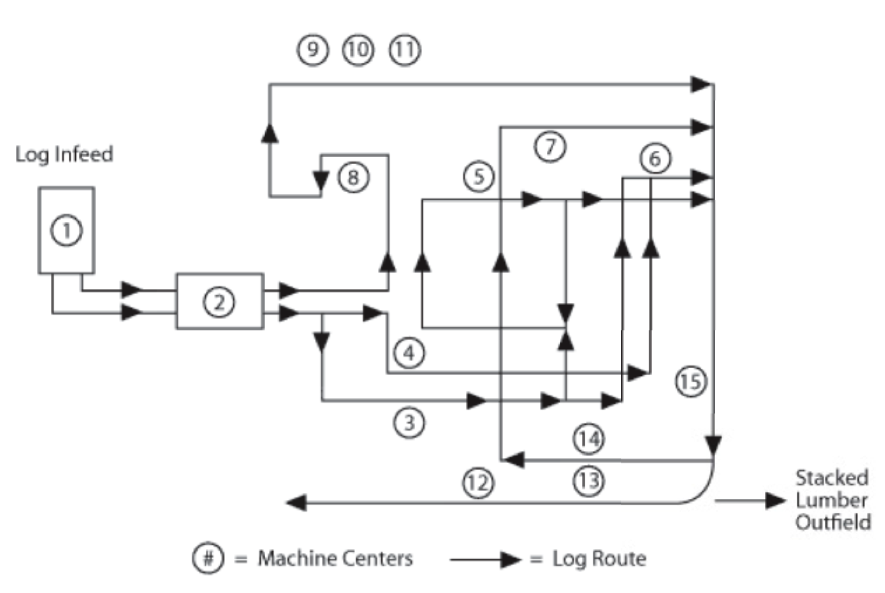
At Maine Woods Company, we use a variety of industry leading, state of the art equipment to achieve maximum efficiency and produce the highest quality products. Even with the best equipment, it is our skilled employees that make everything function smoothly. View our gallery to see photos of our equipment or scroll down to see our equipment in action!
- Log transfer
Area where logs are received from yard - Debarkers
35” Valon Kone 5-Arm Ring Debarker and RosserHead Debarker
Debark logs for sawing - Maximill
2-Albany 5′ bandsaws coupled with 2-Coe/Ahlstrom canter heads (chipper knives and saw blade combination)
Saws logs between 6″-15″ in diameter
Capacity of 3 logs/min - Headrig with carriage
McDonough 7-8A 17 degree tilted bandmill and Corley 17 degree tilt super heavy duty straight line, 36″ opening, 3 headblock carriage with 3-D scanning and linear positioner
Saws logs over 16″ in diameter 8′-14’ lengths
Capacity of 1 log/min - Resaw
McDonough 7-8A vertical band with precision moveable linebar and return “merry-go-round”
Chooses best face to cut from headrig cants
Capacity of 9-10 lumber pieces/min - Combo-Edger
8″ X 60″ Schruman, split press roll, 500hp (2-250hp) bottom arbor, #3 splined, climb cut edger
Saws cants from Maximill, Headrig, and Resaw
Capacity 4 to 6 cants/min and 11 lumber pieces/min - Board Edger
Schruman 3-saw shifting edger with Servo controls
Edges board to 4 sides to maximize grade and recovery
Capacity of 30 pieces/min - Minimill
Composed of a 5′ Albany double-cut band headrig, 3-D scanning, a Serig hydraulic powered 2-knee carriage with a 24″ opening complete with tempasonic hydraulic cylinders, a 2 saw short wood edger, and a 24″ log turner
Saws logs from 6″ to 30″ in diameter with lengths 4′ to 8′
Up to 1/2 log/min - Planer (Downstairs)
Two-sided
Planes 1″ to 36″ wide and 4′ to 14′ lengths
Added value for some customers - Compressor Room (Downstairs)
Variable output and frequency drive
Control on demand
Provides for some mill heat on demand
$43,000 state rebate for electrical savings initiative - Rip Line (Downstairs)
Capacity of 30 MBF/day
Added value initiative in poor market - Bin Sorter
A complete 62 bin sorter
Sorts lumber by grade, length and thickness
Lumber end stamped with grade, grader and bin number - Trimmer
Precision drop trimmer with Autolog controls
Capacity of 80 pieces/min
Trims lumber to maximize recovery and grade
New dust collection system - Hula Saw
Grades and trims cants to lengths
Recycles boards for regrading and edging - Grading Table
3 NHLA trained graders
Capacity of 80 pieces/min
Initial lumber grading station for mill
Stackers
A lumber stacker for solid or kiln ready packages
Kilns
Two 50,000 BF and four 100,000 BF American Wood Dryers track kilns with protected infeed and outfeed. Total dry kiln capacity of 500 MBF
Dry Line—Maine Woods Company recently installed a new dry line facility which became operational mid-September 2015. The line is manufactured by Piche and is capable of processing 60,000 BF of dry lumber per shift, equivalent to 15.5 MMBF annually.Total sawmill production capacity of 18 MMBF/year
Maine Woods Company Overview Video